
News

Cabildo to create a network of 40 photometers to monitor the quality of the night sky

The stations will be located throughout the island and will mainly cover the network of astronomical viewpoints.

Palma Smart Island, will create a network of stations composed of 40 photometers, sensors for online monitoring of night sky quality parameters on the island of La Palma. The stations will be located throughout the island and will mainly cover the network of astronomical viewpoints, as these are the most frequented points by astronomy enthusiasts to observe the firmament.

As Pascual explains, “the objective of this sensor network is to monitor the quality of the night sky for stargazing, offering citizens, especially those interested in astronomy, a public access tool that allows them to see in real time the quality of the night sky for their observations”.

The councilor recalls that during the last few years the Innovation Service of the Island Council of La Palma has been developing the La Palma Smart Island project in a clear commitment to Information and Communication Technologies (ICT) as mechanisms of transformation and economic and social development. “Within this framework, we intend to progressively provide the whole island with infrastructures, resources, incentives and programs, so that each municipality has within reach the resources that allow citizens to make technology the engine that ensures the improvement of public services and a more equitable and sustainable economic and social growth”, Gonzalo Pascual assures.

One of the fundamental pillars of La Palma Smart Island is precisely to have a network of sensors that allows to capture certain parameters in real time. The network is integrated into the system, which contains several areas of action that will be implemented progressively.

In this case, 40 TESS photometers (tess.stars4all.eu) will be installed in the coming days, which will measure in real time night sky quality parameters, as well as meteorological parameters such as temperature and cloudiness. Two types of sensors will be installed, 20 TESS-W type devices, a standard sensor with wifi connection that has been successfully used by Universities and Research Centers; and 20 TESS-Lora devices, a new prototype developed by the IAC within the European project EELabs (eelabs.eu) that uses the Lora Network of the Cabildo and is self-sufficient in energy with a small solar panel.

For this project the Cabildo de La Palma has had the collaboration of the European project EELabs coordinated by the Instituto de Astrofísica de Canarias.

The data can be downloaded from the open data portal, and consulted in real time on a specific web portal (https://tess.dashboards.stars4all.eu/).

The Innovation Service has already predetermined several points on the island to establish the network, whose locations have been consulted with astronomy professionals, although requests or suggestions for establishing new points in other locations are open to those who wish to participate via email to servicio.innovacion@cablapalma.es.
The Cabildo will offer real time information on public transport service at bus stops

The Cabildo Insular de La Palma has put out to tender a project for the supply and installation of an information system for regular public transport users by means of information panels to be installed at 16 bus stops. The panels will display, in real time, the estimated arrival times of the bus at the bus stops in their surroundings, as well as other information related to the service.

The initiative is part of the global project La Palma Smart Island, which aims to gradually incorporate the use of communication technologies in the society of La Palma. The project has a base bidding budget of 220,000 euros, financed by the Canary Islands Development Fund in line 1 of Research, Development and Innovation.

The acting island councilor for New Technologies, Jorge González, and the acting island councilor for Transport, Laura Paz, agree in pointing out that “with this project, public transport by bus in La Palma continues to advance steadily on the path of an effective modernization of the service, which is taking shape in measures that favor comfort, information and interaction with users”.

The entry into operation of the information panels is subject to the new buses of the regular public transport service incorporating GPS systems this summer that allow the geolocation of the vehicles, so that the aforementioned information on route and schedule is offered. In addition, the company awarded the service, Transportes Insular La Palma (TILP), has already made available to users an application (app) for mobile devices in which this information can also be consulted.

To date, the Innovation, Projects and Information Society Service of the Island Council of La Palma has already installed, as a pilot project, two information panels of this type at the main bus stop in Santa Cruz de La Palma, at the island’s airport, and will soon install one at a bus stop in Los Cancajos, in Breña Baja.

The Cabildo begins to implement an Insular Network of sensors to measure air quality

The Cabildo Insular de La Palma, through the Department of New Technologies directed by Jorge González, will implement an insular network of sensors to measure air quality. The Innovation, Projects and Information Society Service has already installed the first six stations dedicated to the real-time monitoring of air quality parameters.

One of the main pillars of the new project is to have a network of sensors to capture different parameters in real time. This network is integrated into the system, which contains various fields of action that will be implemented gradually.

In this case, six air quality stations have been installed by the company Hop Ubiquitous, which measure in real time air quality parameters such as particles and gases, as well as meteorological parameters such as temperature, humidity, atmospheric pressure and luminosity.

The primary objective of this project is real-time monitoring of air quality. The stations will be located in Santa Cruz de La Palma, Breña Alta, Fuencaliente, Los Llanos de Aridane, Puntagorda and Barlovento.

The data can be downloaded from the open data portal Open Data La Palma, and consulted in real time at http://calidadaire.lapalma.es.

The Cabildo is committed to this new initiative within the framework of the global project La Palma Smart Island, which is progressively providing the entire island with infrastructures, resources, incentives and programs that allow institutions and citizens to make technology the engine that ensures the improvement of public services and a more equitable and sustainable economic and social growth.

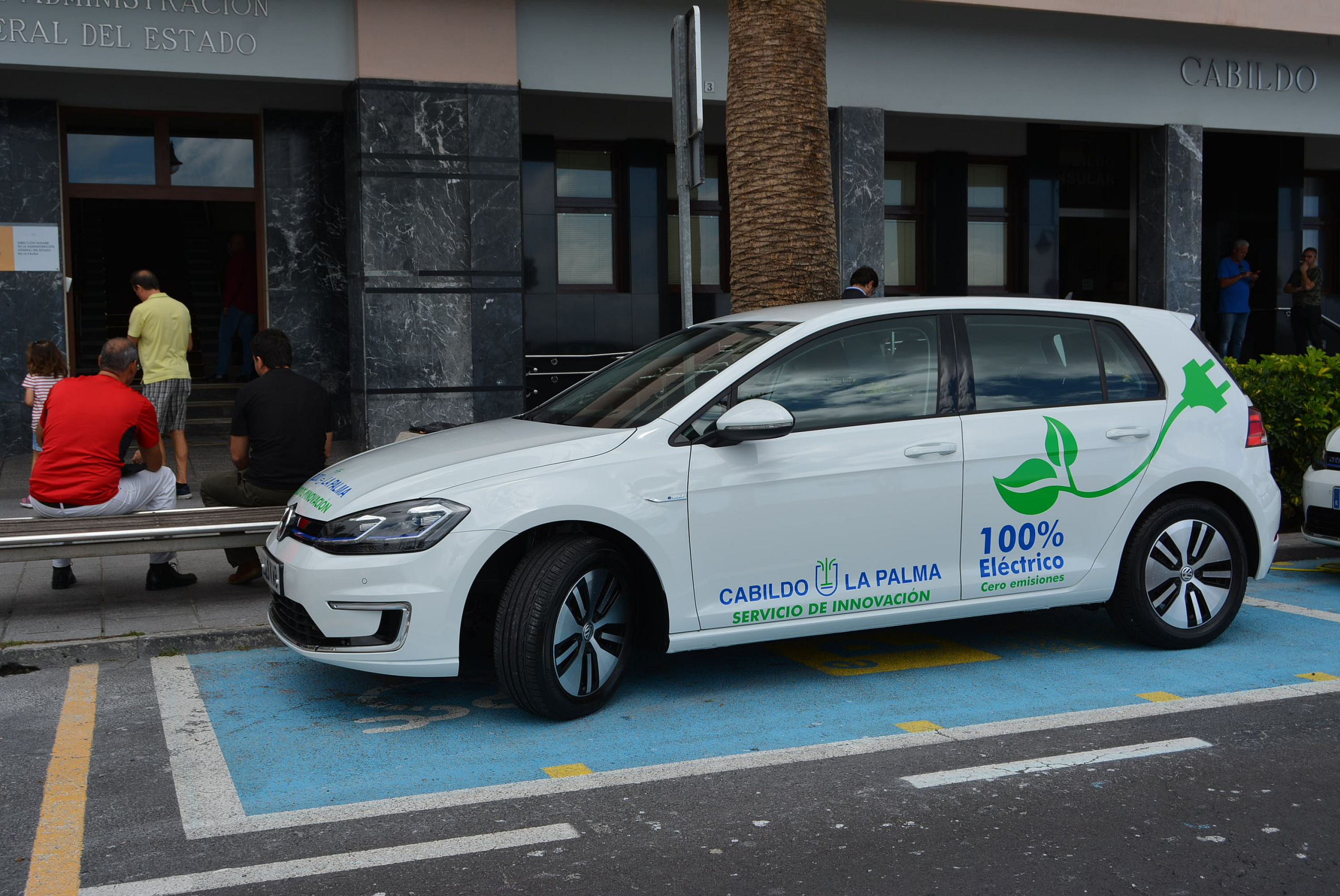
The Cabildo adds its first 100% electric vehicle to its fleet of vehicles

The new electric car of the Island Corporation is a Volkswagen e-Golf, a non-polluting, five-seater car with a range of 300 kilometers. Its cost has been 29,799 euros.

The Cabildo Insular de La Palma has incorporated a 100% electric vehicle to its fleet, which will be destined to the Innovation, Projects and Information Society Service, under the Department of New Technologies. This is the first vehicle of these characteristics to be added to the fleet of the island institution, which to date also has two hybrid vehicles in the Presidency Service.

The new electric car of the Island Corporation is a Volkswagen e-Golf, a non-polluting, five-seater car with a range of 300 kilometers. Its cost has been 29,799 euros.

“The Cabildo maintains a coherent and consistent line with the policies and projects promoted to continue making La Palma an ideal place to implement innovative and sustainable measures,” said the Minister of Infrastructure and New Technologies, Jorge Gonzalez.

It should be recalled that the Cabildo de La Palma has already made available to the public the first charging points for electric vehicles of an island network that will continue to increase its capacity and has promoted the celebration of three fairs dedicated to electric vehicles on the island.

El Paso and Breña Alta host children’s educational robotics workshops with more than 25,000 Lego pieces

“The activity, promoted by the Cabildo, the Canary Islands Agency for Innovation and the municipalities of both municipalities, will take place on December 28 and January 4 at the fairgrounds and the Agromercado, respectively.”

Boys and girls from La Palma between 5 and 14 years old will become “engineers and architects of a smart city thanks to a set of robotics and constructive creativity workshops to be held on December 28 and January 4 in the municipalities of El Paso and Breña Alta, respectively,” according to a press release from the Cabildo. “The challenge,” it adds, “will be to build these cities with more than 25,000 Lego pieces in which, along with robots, participants will have to overcome different challenges.

The activity, which will take place at the fairgrounds Pasense and Agromercado del Parque de Los Alamos, is part of the scientific Christmas program, an initiative of the Ministry of Economy, Industry, Trade and Knowledge of the Government of the Canary Islands, through the Canary Islands Agency for Research, Innovation and Information Society (ACIISI) that seeks to bring science is its various fields to young people of different ages. This project is also promoted by the Cabildo Insular de La Palma, from the area of New Technologies directed by Jorge González, and has the collaboration of the town councils of El Paso and Breña Alta.

The city built in Breña Alta will be on display from January 5 until the 12th, and can be visited by those who come to the Agromercado del Parque de Los Álamos. Places to participate in these workshops, which will be held from 9:30 to 14:00 hours, are limited. Registrations should be made by calling 620 599 073 and / or 622 395 100.